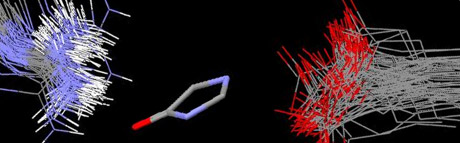
Barrel Shape and Chromophore Rigidity Predict Fluorescent-Protein Photophysics
Document Type
Article
Publication Date
2026
Abstract
The 11-stranded β-barrel of fluorescent proteins (FPs) is universally conserved, yet its quantitative geometry has not been systematically characterized. We analyzed cross-sectional barrel geometry across 908 FP crystal structures in the RCSB PDB by principal component analysis (PCA)-based axis determination and convex hull analysis of protein-atom slices at the chromophore plane; 780 structures (210–245 residues, with the chromophore-containing chain selected in FP-complex cocrystals) form the canonical analysis cohort. Barrel shape, but not size, correlates with emission wavelength: red-shifted proteins have narrower, more elliptical barrels (ρ = −0.328 for minor axis, p = 2.2 × 10⁻¹⁷). Fluorescence quantum yield, by contrast, is not governed by barrel size: it tracks how rigidly the barrel holds the chromophore (chromophore-to-barrel B-factor ratio, ρ = −0.49 per unique FP), together with the chromophore’s ground-state planarity (ρ = −0.42) as an independent signal of comparable strength. The planarity term is most pronounced among red fluorescent proteins, which span the widest range of ground-state twist. Principal correlations survive Benjamini–Hochberg correction and partial correlation controlling for resolution. The barrel is not a passive scaffold: it constrains chromophore rigidity and thereby shapes photophysical output. The pipeline was developed with Claude (Anthropic) via Claude Code.
Recommended Citation
Begg, Luke P.; Mason, Madeline L.; and Zimmer, Marc, "Barrel Shape and Chromophore Rigidity Predict Fluorescent-Protein Photophysics" (2026). Chemistry Faculty Publications. 12.
https://digitalcommons.conncoll.edu/chemfacpub/12
The views expressed in this paper are solely those of the author.
Comments
Originally published in the Journal of Chemical Information and Modeling (2026) 66 (16): 10266–10276.
https://doi.org/10.1021/acs.jcim.6c01606
PubMedCentral PMCID: PMC13508766