Document Type
Honors Paper
Advisor
David Dorfman and Shawn Hove
Publication Date
2026
Abstract
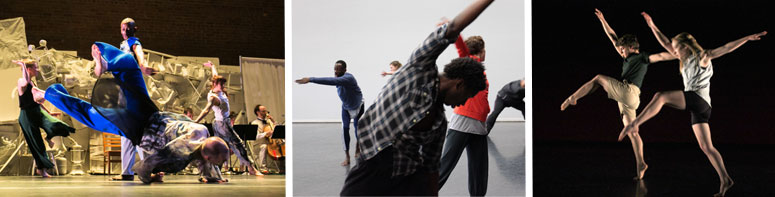
This thesis investigates otherization and its use as a tool for power through theoretical, historical, and movement based investigations. Over the course of this academic year, I worked with a group of Connecticut College dancers in weekly rehearsals to build choreography and to hold discussions. This took place alongside external, independent research into thinkers and artists from Jean-Jacques Rousseau to Martha Graham, theories by historians such as Edward Said, and both historical and current events. These elements were not approached sequentially, but simultaneously, with the intention that each element influence and inform the others. I reference this variety of topics not with the intention of summarizing them, but in order to take what applies as evidence to the existence of othering across disciplines and time.
My work concluded with the presentation of my thesis performance on March 27 & 28, 2026, and with this written analysis. Through my rehearsals, individual investigations, and kinetic explorations with my dancers, I conclude that otherization can be countered only through intentional acknowledgment and accountability taken by the implementers and bystanders of othering. I argue that the investigation of societal themes through dance alongside academic research allows for a uniquely holistic understanding of the work being done.
Recommended Citation
Brankman, Emily, "one, and other, one another, another (again): A Historical and Embodied, Kinetic and Theoretical Investigation of Otherization" (2026). Dance Department Honors Papers. 30.
https://digitalcommons.conncoll.edu/dancehp/30
Media Format
flash_audio
Included in
The views expressed in this paper are solely those of the author.
Comments
Winner of the 2026 Oakes and Louise Ames Prize.